Fridge Running Nonstop and Never Shutting Off? Here's What That Means for Your Compressor
Quick Answer: A refrigerator that never cycles off isn't "working overtime" by design — it's compensating for a system that can't recover on its own. The most common causes are dirty condenser coils, a door gasket that's stopped sealing, blocked airflow inside the cabinet, or frost that's built up over the evaporator coil faster than the defrost cycle can clear it. Less often, a refrigerant leak or a compressor nearing the end of its life is behind it. Checking the coils and the door seal first resolves a large share of cases before a technician ever needs to open the cabinet.
You reach for something in the kitchen after everything else in the house has gone quiet, and the refrigerator is still humming the same way it was an hour ago — and the hour before that. A healthy fridge cycles: it runs for a while, reaches its set temperature, and shuts off to rest before the next cycle starts. When that pattern disappears and the compressor just keeps going, the appliance isn't broken by definition, but it's telling you the system can't catch up to whatever is working against it.
Why Your Fridge Is Built to Cycle, Not Run Straight Through
The compressor pressurizes refrigerant and pushes it through the coils, where it absorbs heat from inside the cabinet and releases it into the room. A thermostat or electronic control watches the interior temperature. It switches the compressor off once the set point is reached, then back on when the temperature drifts back up. That on-and-off rhythm isn't incidental — the motor, the start components, and the lubricating oil inside the compressor are all built around getting a rest period between runs. Oil needs the off-cycle to settle and redistribute through the moving parts. Skip that rest, and the internal components run drier than they're designed to.
So when a refrigerator runs continuously, the compressor isn't failing on its own most of the time — something else in the system is preventing it from ever reaching that set point, and it just keeps trying.
Dirty Condenser Coils Are the Most Common Cause
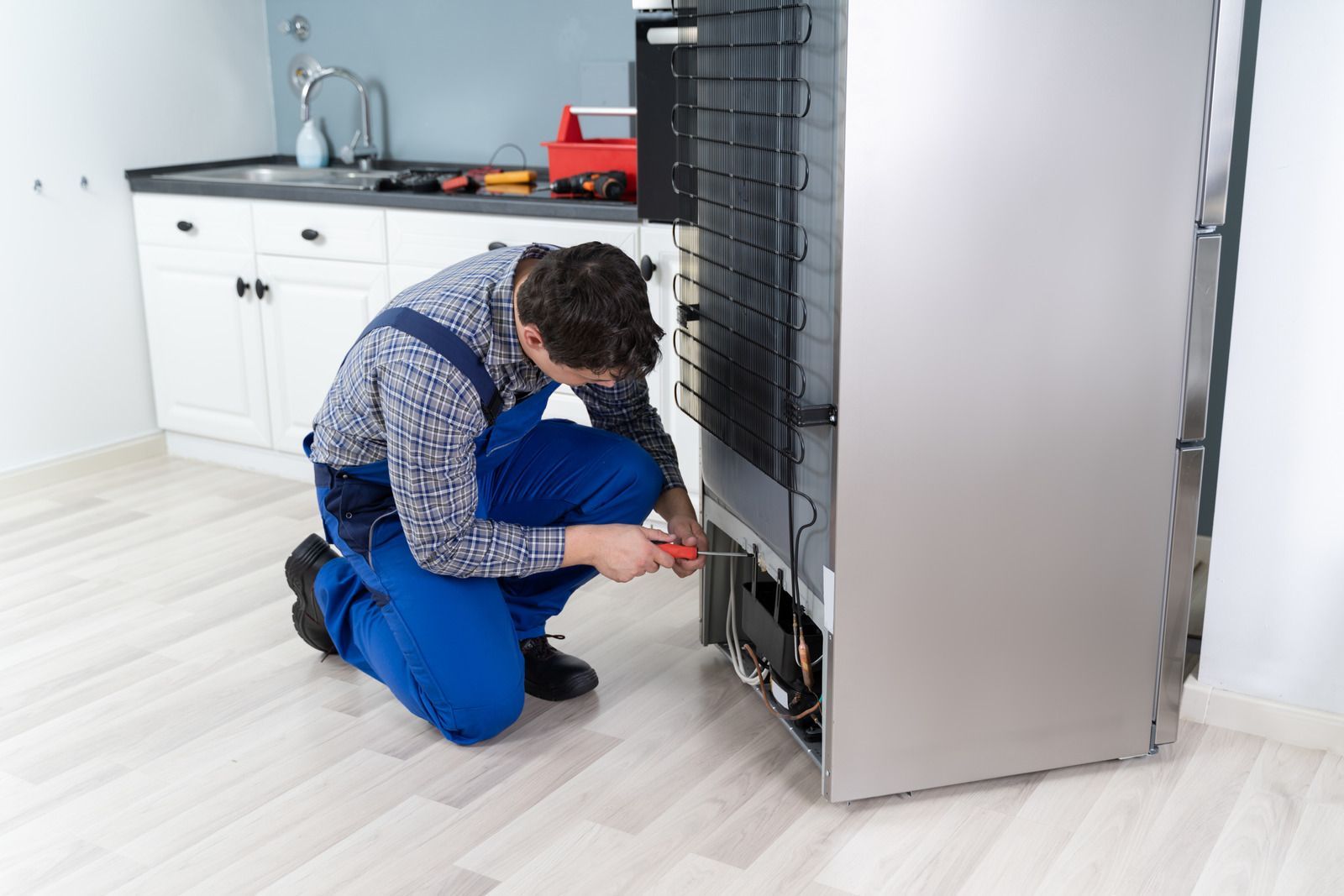
What the coils actually do. The condenser coils, usually at the back or underneath the fridge, are where the refrigerant releases the heat it picked up from inside the cabinet. Dust, pet hair, and kitchen grease settle on those coils over time and act like insulation. A coil caked in fuzz is doing exactly what a blanket would do — trapping heat right where it needs to escape. The coils can't shed heat efficiently, so the compressor has to run longer and harder to move the same amount of heat out of the box.
Why this shows up more in Front Range homes than you'd expect. Along the Lakewood, Golden, and Denver corridor, homes see a lot of seasonal dust. Plenty of kitchens also have a resident dog or cat shedding near the floor vents where the coils pull air. Most manufacturer guidance skips coil cleaning for a typical low-dust household, but calls for a check every three to six months in homes with pets, heavy kitchen traffic, or nearby construction dust — which covers a lot of houses in this area.
What to check. Pull the fridge away from the wall, or remove the bottom kick-plate grille on models with front-mounted coils. Unplug it first. Then look at the coils with a flashlight — a visible layer of gray fuzz is probably why the compressor won't quit.
A Door Seal That's Lost Its Grip
The rubber gasket running around the door only needs one soft or gapped section to undo the whole seal. Once warm, humid kitchen air has a path in, the interior temperature never settles at the set point, and the compressor has no cycle to complete — it just keeps trying to catch up to air that keeps arriving.
A simple way to check it. Close the door on a piece of paper or a bill so that half hangs outside the door. Pull it out slowly. If it slides free with little resistance, or falls out on its own, the gasket isn't gripping firmly enough at that spot. Repeat the test at several points around the door — top, bottom, both sides, and each corner — because a gasket usually fails in one localized section rather than uniformly.
Signs to watch for besides the test. Condensation or frost forming near the door frame. A shelf closest to the door that's noticeably warmer than the rest of the cabinet. Cracking or hardening in the rubber when you run a finger along it. And it's not always the rubber itself — food and spill residue trapped in the gasket's folds can stop it from compressing evenly, and in that case a thorough cleaning with mild soap and warm water sometimes restores the seal without a full replacement.
Blocked Airflow Inside the Cabinet
Refrigerators depend on fans circulating cold air around the compartments, not just the compressor cooling a static space. If the evaporator fan's airflow is blocked — usually by food packed too close to the vents in the back of the freezer or fridge — the thermostat sensor won't register that the target temperature has been reached, even if plenty of cold air is technically being produced. The control system doesn't know that. As far as it can tell, the fridge still isn't cold enough, so the compressor keeps running.
What to check. Look at the vents on the back interior wall of both compartments and make sure nothing — a large container, a stack of leftovers, a rogue pizza box — is pressed directly against them. A general rule from appliance technicians is to keep roughly an inch of clearance between stored food and the interior walls where the vents sit.
When the Defrost System Falls Behind
Modern frost-free refrigerators run a defrost cycle automatically, using a heater to melt any frost that accumulates on the evaporator coil so it doesn't insulate the coil from the air passing over it. If that defrost heater, its timer, or the sensor that controls it stops working correctly, frost keeps building instead of clearing. A thick layer of frost on the evaporator acts the same way dust on the condenser coils does — it blocks efficient heat transfer, so the compressor runs longer trying to compensate, and the freezer or fridge compartment may still feel warmer than it should even with the compressor working overtime.
Tip: If your fridge has a manual "force defrost" mode (check the owner's manual — many models trigger it by pressing a door or freezer button several times within a couple of seconds), running it once can tell you a lot. If the compressor finally quiets down and the temperature drops normally afterward, frost buildup was very likely the culprit. If it doesn't change anything, the problem is probably somewhere else in the system.
Checking Airtightness and Fan Function Rules Out the Common Causes
But you don't need to guess at which one it is before doing anything. Between a dirty coil check, the door seal test, and a look at the interior vents, most continuously running refrigerators get explained without opening up the sealed system at all. Working through those checks in order — coils, then seal, then airflow — before assuming something more serious is happening saves a technician visit for the cases that actually need one.
Less Common but More Serious Causes
A refrigerant leak. If the sealed refrigerant system has developed a leak, the fridge physically cannot reach its set temperature no matter how long the compressor runs, because there isn't enough refrigerant left to carry heat out of the cabinet efficiently. This isn't something to diagnose or top off yourself — recovering, evacuating, and recharging refrigerant requires specialized equipment and EPA-certified handling, so this is squarely a call-a-technician situation.
A compressor or inverter board nearing failure. Newer refrigerators increasingly use inverter-controlled compressors that vary their speed instead of switching fully on and off. When the inverter board itself starts failing, the compressor can get stuck running at a fixed speed instead of cycling down, which looks identical to a "won't shut off" fridge from the outside. On older single-speed compressors, a failing start relay or an aging motor can produce the same continuous-run symptom as it struggles to restart cleanly after each attempt.
Warning: A refrigerator that's been running continuously for more than a day or two isn't just running up the electric bill — the extended heat buildup around the compressor's motor windings and start components accelerates wear that a normal on-off cycle would never put it through. If a coil cleaning and a door seal check don't bring the cycling pattern back within a day, don't wait it out much longer before having it looked at.
What a Technician Checks That You Can't From the Outside
A visual coil check and a gasket test cover the surfaces you can reach, but diagnosing a compressor, inverter board, or refrigerant charge accurately requires instruments a homeowner typically doesn't have on hand — a clamp meter to read the compressor's actual running amperage, a capacitor tester, and gauges to check refrigerant pressure on the sealed system. A technician can also confirm whether a component that looks fine (a fan that spins freely by hand, for instance) is actually pulling correct voltage and drawing normal current under load, which a visual check alone won't reveal.
Frequently Asked Questions
Is it normal for a refrigerator to run for hours at a time?
Running for a long stretch after the door has been open, after loading warm groceries, or during a hot afternoon is normal — the compressor is catching back up. What's not normal is never pausing.
Will a refrigerator that runs constantly eventually stop cooling completely?
It can, especially if frost is burying the evaporator coil or refrigerant is leaking. In both cases, the compressor's effort grows less effective over time, and interior temperature can climb while the compressor keeps running.
How long can a compressor run continuously before it's damaged?
There's no fixed number of hours, since it depends on the cause and the compressor's condition going in. What matters more is how long the issue goes unaddressed — a day or two beats weeks.
Can overloading the fridge with groceries cause it to run nonstop?
Temporarily, yes. A large grocery haul or a big batch of leftovers still cooling from room temperature makes the compressor work harder and longer for a stretch. That's different from one that never cycles off.
Does a refrigerator running constantly always mean the compressor itself is bad?
No — a bad compressor is one of the less common explanations. Dirty coils, a failing door gasket, blocked airflow, and defrost problems account for most continuously running refrigerators, and are all worth checking first.
Why does my fridge run more at night?
Kitchens run warmer during the day from cooking and activity, so the compressor cycles accordingly. At night, a healthy fridge should cycle less — if you're seeing the opposite, rule out a poorly sealing door.
What a Nonstop-Running Refrigerator Is Telling You
A refrigerator that refuses to cycle off isn't malfunctioning by definition — it's signaling that something in the system can't keep pace with whatever it's up against. Dust-caked condenser coils, a failing door gasket, blocked interior airflow, and frost overtaking the evaporator coil explain most of these cases, and each is something you can check within minutes. Working through them in order, starting with the coils, resolves most continuously running fridges long before anyone needs to open up the sealed system.
Homes around Lakewood, CO see enough seasonal dust and pet dander that coil buildup shows up faster than most guidance accounts for, which is exactly why it's worth ruling out first. A day or two of continuous running while you check coils, gasket, and airflow is reasonable; weeks of it usually isn't. Any Appliance Care & Repair
has spent 10
years tracing a fridge that won't shut off back to whichever piece of the system stopped holding up its end.